






 LIGHT
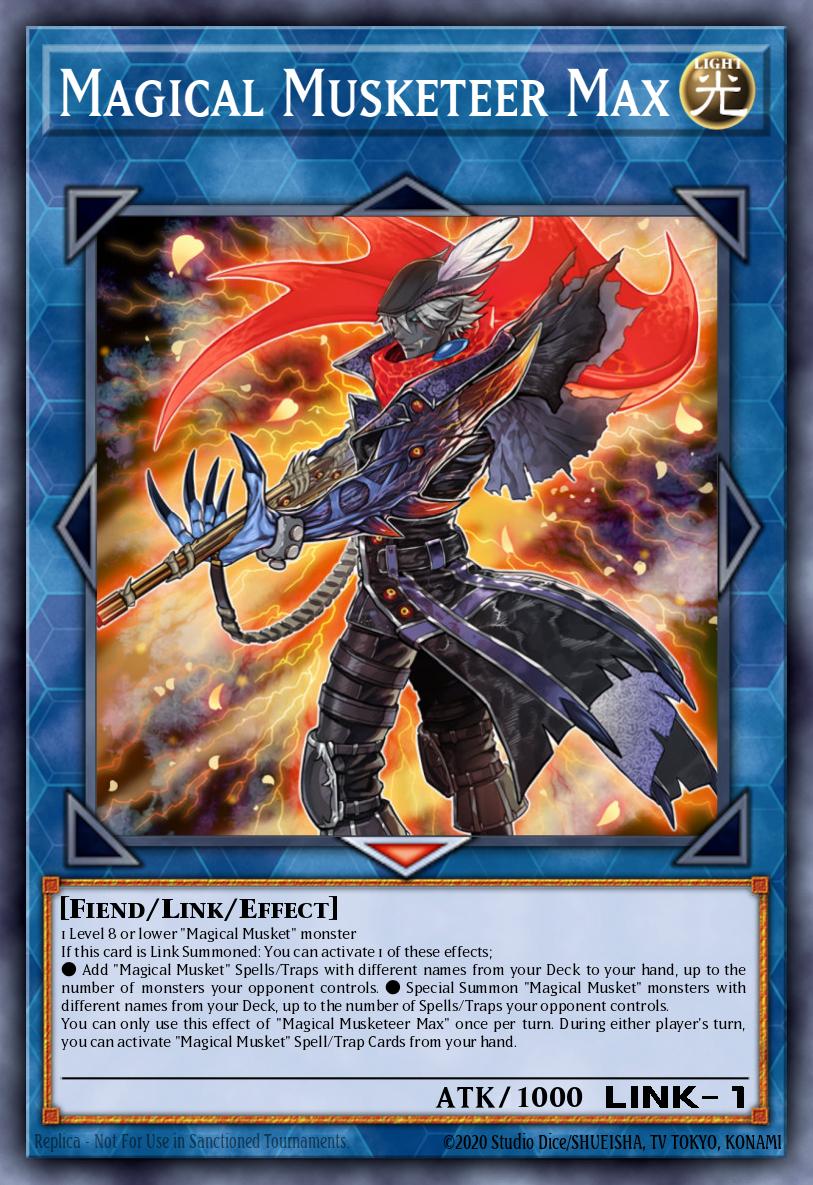
Magical Musketeer Max
Archetype:
Magical Musket
ATK:
1000
LINK-1
View:
4641
Link Arrow:
 Bottom
1 Level 8 or lower "Magical Musket" monster If this card is Link Summoned: You can activate 1 of these effects; ● Add "Magical Musket" Spells/Traps with different names from your Deck to your hand, up to the number of monsters your opponent controls. ● Special Summon "Magical Musket" monsters with different names from your Deck, up to the number of Spells/Traps your opponent controls. You can only use this effect of "Magical Musketeer Max" once per turn. During either player's turn, you can activate "Magical Musket" Spell/Trap Cards from your hand.
Magical Musketeer Max — Power Evaluation
Final Score: 65 ± 4 · Confidence: Medium
- Intrinsic: 63 · Deck: 66 · Meta: provisional
- Primary role: Searcher / Tutor · Secondary: Combo enabler, Extender
Why it scores here
Magical Musketeer Max serves as the primary tutor and enabler for the Magical Musket archetype, tutoring key spell/traps or summoning monsters to advance the deck's control-oriented game plan. Its 100% inclusion rate and strong partnership with core Magical Musket and Fiendsmith cards demonstrate reliable accessibility within its archetype homes. However, the effect's dependence on opponent's board state for scaling, lack of inherent disruption or resilience, and archetype-specific nature limit its universal power. The single recorded combo showing a 100 power index with +3 card advantage indicates strong integration, but thin combo evidence prevents higher scoring.
Axis scores
| Axis | Score | Evidence |
|---|---|---|
| Accessibility | 75 | Requires a Level 8 or lower Magical Musket monster to summon; highly accessible in Magical Musket decks with 99% co-incidence with Caspar and core Musket bodies (verified). |
| Combo & Conversion | 65 | Tutors Magical Musket spells/traps or summons monsters based on opponent's board; the single recorded combo achieves power index 100 with 2 end monsters, 2 bosses, and +3 net card advantage (observed). |
| Resource Economy | 68 | Generates filtering and search advantage via tutoring or summoning, though once-per-turn and opponent-board-dependent; contributes to the +3 net advantage seen in the combo example (observed). |
| Effect & Interaction | 45 | Does not provide direct negation, removal, or disruption; enables opponent interaction only through the continuous spell/trap activation effect, which depends on cards other than Max (inferred). |
| Material Utility | 55 | Provides a Link-1 Fiend body usable as material for further summons, acceptable but thin as material (1000 ATK, Link-1 arrows limit utility); usable even when effect-negated (inferred). |
| Resilience & Flexibility | 50 | A one-time on-summon effect with no built-in protection or resilience; resummoniable as a Link but fragile to interruption during the first summon (inferred). |
| Deck-Building Efficiency | 70 | Requires Magical Musket monsters for activation, a mild archetype restriction; 1.12 average copies and 100% inclusion show no garnet issues in homes where it belongs (verified). |
Calculation
Weight profile: 0.7 Searcher/Tutor + 0.3 Combo enabler. Intrinsic ≈ 63, Deck ≈ 66, Meta = provisional. Modifiers: none. Final formula: 0.40*Intrinsic + 0.60*Deck
Strengths
- 100% inclusion rate across all 400 studied decks confirms reliable accessibility within archetype homes
- Central tutoring effect scales adaptively with opponent's board state (monsters summoned = S/T tutored; S/T played = monsters summoned)
- Continuous ability to activate Magical Musket spells/traps from hand enables the archetype's control and surprise interactions
- Broad archetype presence: appears in 23 distinct deck types, primarily Magical Musket and Fiendsmith hybrids
- Strong synergy with core archetype cards (99% co-incidence with Caspar; 98%+ with Fiendsmith support)
Weaknesses
- Lack of inherent disruption, negation, or removal—relies entirely on spell/trap cards for interaction
- Once-per-turn effect limits repeated advantage generation within a single turn
- Effect scaling is passive and opponent-dependent: low opponent board state = minimal tutoring upside
- Link-1 body with only Bottom arrow limits material utility for future summons
- Requires specific Magical Musket Level 8 or lower monster for summoning; not a generic splash card
- Fragile to interruption once summoned; no inherent protection or resilience mechanisms
Counters / choke points
- Negate the Link Summon effect (Solemn Judgment, Solemn Strike) to prevent tutoring or summoning
- Remove the Link body after summoning but before effect activation (Kaiju, effect removal)
- Lock down Magical Musket spell/trap activation with broad S/T disruption
- Reduce opponent's monster count early to minimize the scaling of Max's tutor effect
Best use
Primary tutor and enabler for Magical Musket spell/trap activation and monster summoning engine. Decks: Magical Musket, Fiendsmith, Unchained (with Magical Musket engine), Azamina (with Magical Musket hybrid). Suggested copies: 1.
Evidence & gaps
- Verified: Card text and effects are clearly defined and complete; 100% inclusion rate in all 400 studied decks; Appears in 23 distinct archetype homes; 99% co-incidence with Caspar and other core Magical Musket monsters; No banlist restrictions (assumed unlimited 3 copies)
- Observed: Average 1.12 copies per deck confirms no garnet issues; Strong synergy with Fiendsmith engine (98%+ co-incidence); Single recorded combo achieves power index 100 with +3 net card advantage; Central presence in both pure Magical Musket (28.2%) and Fiendsmith hybrid (28%) decks
- Inferred: Tutoring effect provides resource economy through filtering and search advantage; Continuous effect enables the archetype's interaction suite by allowing spell/trap activation from hand; As Link-1 Fiend, usable as material for further summons even when effect-negated; Card is central to Magical Musket game plan based on 100% inclusion and guide descriptions
- Data gaps: Only 1 combo recorded with empty role details; unclear whether Max acts as starter, searcher, material, or payoff in that sequence No detailed breakdown of how often tutor vs. summon effect is chosen in practice No metagame ranking or Top Card status (thin meta context) No explicit ruling clarifications on once-per-turn application timing